

Selling
How to Sell a Dental Practice in California: The Full Process, Start to Finish
TL;DR
- Plan for roughly a year from the day you decide to sell to the day you close. The fast part everyone quotes (4 to 6 weeks) is only the final closing phase, not the whole journey.
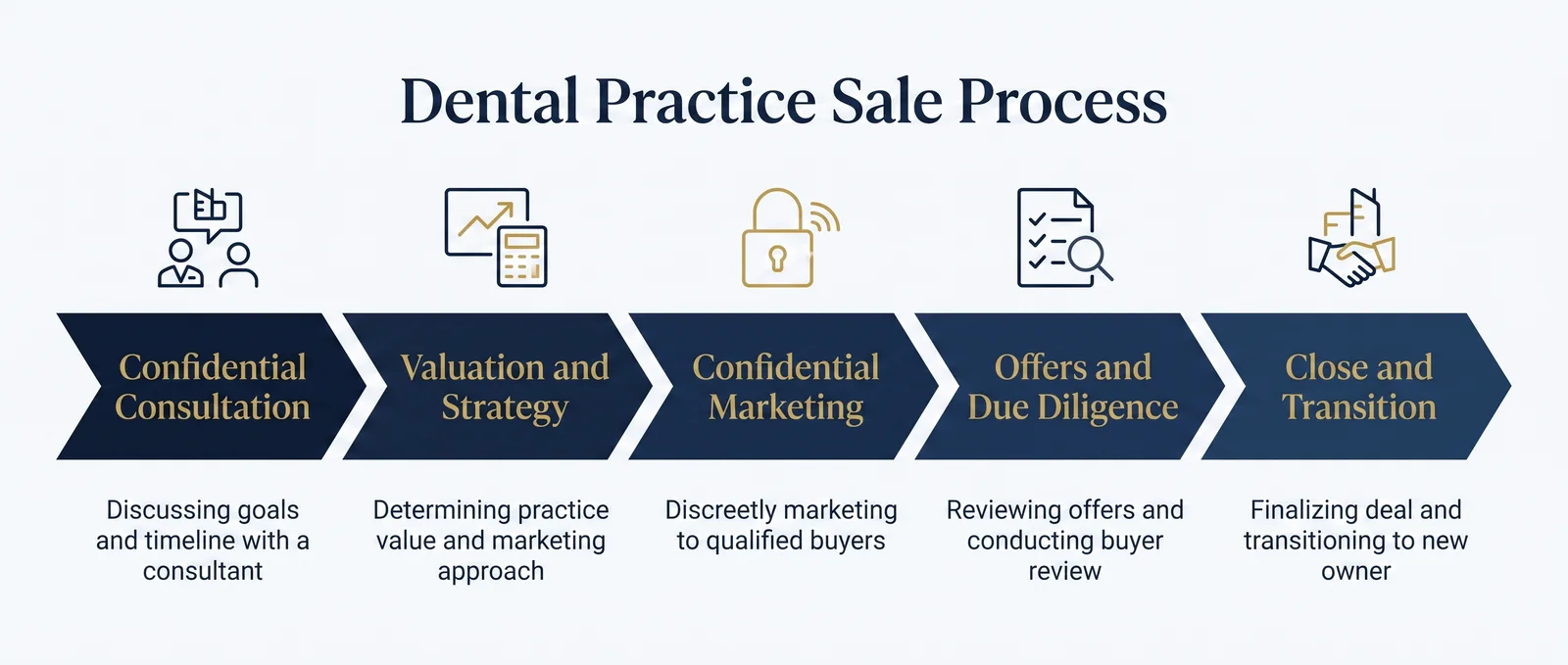
- The sale runs through five stages: a confidential consultation, a valuation and go-to-market strategy, confidential marketing, offers and due diligence, then close and transition.
- A proper valuation drives everything. Earnings matter more than revenue, and the rule-of-thumb numbers most sellers rely on are often wrong.
- There are two main buyer types in California: another dentist or a dental support organization (DSO). The right fit depends on your goals, not just the headline price.
- The single most common reason a sale stalls is mispricing, usually pricing too high. Most deal-killers are predictable and preventable.
If you own a dental practice in California and you have started thinking about selling, you have probably found that the advice online is all over the map. One article says you can sell in 90 days, the next says it takes three years. Neither is wrong exactly, but neither tells you what the process actually looks like from where you are sitting.
In this post, I’ll walk through the entire process of selling a dental practice in California, from the first confidential conversation to the day you hand over the keys. My goal is simple: by the end, you should understand how the whole thing works, how long it takes, and where the real risks are. I run California Dental Practice Sales (CDPS), and I work with dentists across the state on both valuations and sales, so I’ll share what I see drive these decisions in practice.
If you have a practice for sale in California, or you are simply trying to understand your options, here is the full picture.
How long does it take to sell a dental practice?
Plan for roughly one year from the decision to sell to the closing. That is the honest answer, and setting that expectation early is one of the most useful things I do for a seller.
The reason the internet gives you wildly different numbers is that people are measuring different things. The American Dental Association notes that the ideal window from listing to closing is about 4 to 6 weeks. That number is real, but it describes only the final stretch, after you have already prepared the practice, priced it, marketed it confidentially, and found a qualified buyer. Everything that comes before that is where the time actually goes.
A realistic year breaks down into something like this: a few weeks to prepare and value the practice, a few months of confidential marketing to reach the right buyers, several more weeks for offers and due diligence, then the closing phase. Each piece can move faster or slower depending on your location, your numbers, and how organized your financials are. The cleaner your records, the tighter the timeline.
The practical takeaway: start earlier than you think you need to. A seller who plans a year ahead has the leverage to fix problems and wait for the right buyer. A seller in a hurry tends to leave money on the table.
The five stages of a dental practice sale
Most sales move through the same five stages, and knowing them ahead of time takes a lot of the anxiety out of the process. Think of it less as a single event and more as a sequence, each step setting up the next.
The arc looks like this: you start with a private conversation about your goals, then build a defensible price and a plan to reach buyers, then go to market, then work through offers and due diligence, and finally close and transition the practice to its new owner. Here is what each stage involves.
Stage 1: The confidential consultation
Everything starts with a private, no-obligation conversation about your goals, your timeline, and what a good exit actually looks like for you. Some dentists want to retire fully and walk away. Others want to slow down but keep treating patients. Those are very different plans, and the right strategy depends on which one is yours.
Stage 2: Valuation and go-to-market strategy
Next comes a certified valuation and a strategy built around it, including which types of buyer fit your goals. This is the foundation of the whole sale, which is why it gets its own section below. Price the practice wrong here and every later stage suffers.
Stage 3: Confidential marketing
This is the stage that worries sellers most, and for good reason. The practice is marketed discreetly to qualified buyers, and your identity is protected until appropriate confidentiality protections are in place. Your staff and patients should not learn that you are selling before you are ready to tell them. Confidentiality is central to how the process works, not an afterthought.
Stage 4: Offers and due diligence
When serious buyers come forward, they typically submit a letter of intent (LOI), a non-binding document that lays out the basic terms of a proposed deal. Good offers are compared on more than price alone. Then the buyer conducts due diligence, reviewing the financials and operations to confirm that the practice is what it appears to be. This is where clean, accurate records pay off, since gaps and surprises slow everything down and can invite a buyer to renegotiate.
Stage 5: Close and transition
In the final stage, the deal closes and the practice transitions to its new owner. This is a team effort: your attorney drafts and reviews the definitive purchase agreement, your CPA handles tax planning and helps support the financials, and the lender finalizes the buyer’s financing. A smooth transition plan for your team and patients protects the value of what you built.
Why does a valuation matter so much when selling?
Because the valuation sets the price, and the price is the single biggest factor in whether your practice sells at all. Get it right and the rest of the process has a fighting chance. Get it wrong and even a great practice can sit on the market.
A valuation also does something less obvious: it tells you the truth about what you own. One doctor came to me for a valuation during the height of the pandemic. He ran a long-standing family dental corporation his father had started more than 50 years earlier, and between staffing shortages and heavy regulation, he was weighing a DSO buyout offer. We did a full valuation, and in the course of interviewing him in depth I surfaced value drivers he had not been aware of. The valuation revealed the practice’s true value, and with that clarity he decided not to sell. Business has been strong for him since. The right answer was not to take the offer, and a real valuation is what made that visible.
That story captures why I take valuation so seriously. It is not just a number for a listing. It is the basis for one of the biggest financial decisions of your career.
A quick but important note: general market ranges discussed here are observations about the market, not an indication of what any specific practice is worth. The only way to know what your practice is worth is a real appraisal of your numbers.
Rules of thumb are only rules of thumb
Dental practices often change hands somewhere around 70% of revenue, and that shorthand is everywhere. The problem is how much it hides. A multiple-of-revenue figure can be wildly off for a given practice once you look at real profitability.
The data backs this up. One firm that completed 46 valuations of dental practices found that rule-of-thumb estimates undercut the real value in most cases, with the average practice coming in roughly 62% higher under a proper appraisal than the common revenue shortcut implied. If you anchor on a rule of thumb, you are as likely to undervalue your practice as overvalue it. Either way, you are guessing.
Revenue matters. Earnings matter more. What a buyer is really paying for is the cash flow the practice can produce for them, and that is not the same as the top-line number.
The most-missed step: normalizing owner’s compensation
The step most people skip, including many generalist appraisers, is normalizing owner’s compensation. Normalizing simply means adjusting the owner’s pay to a fair market level, what it would cost to hire a dentist to do that clinical work, so you can see the true earnings left over for a buyer.
This matters because investors and DSO buyers value a practice on those normalized earnings, not on whatever the current owner happens to pay themselves. Skip this adjustment and you get the wrong value, sometimes badly wrong. It is technical, it moves the number materially, and it is exactly the kind of thing a defensible valuation gets right.
Who buys dental practices in California?
There are two main types of buyer: another dentist, or a dental support organization (DSO), which is a company that owns the business side of dental practices while licensed dentists continue to provide the clinical care. Which one is right for you depends on your goals, not just on who waves the biggest number.
Individual dentists usually finance the purchase through a bank, often an SBA loan, which is the dominant route for individual practice buyers. That financing has limits, and those limits matter more than most sellers realize. Here is the wrinkle: a highly profitable practice gets valued on its cash flow, and that earnings-based value can climb above the old 70%-of-revenue rule of thumb, sometimes to 100% or more of revenue. At that point a conventional lender often will not finance an individual dentist for the full amount, because lenders cap how much they will lend relative to revenue. When that happens, the realistic buyer becomes an investor or a DSO. In other words, your own strong numbers can quietly move your practice out of the individual-buyer pool.
DSOs also tend to prefer larger practices. After paying the selling dentist a market-rate salary to stay on, there has to be enough profit left for the DSO to earn a return, which is easier on a bigger practice. Matching the practice to the right buyer pool is a core part of full-service brokerage, and it starts with the valuation.
Should you sell to a DSO?
Sometimes, but it is not right for everyone. A DSO can pay a premium, and buy-side demand has been strong, with most DSOs in one 2026 survey planning to increase their acquisitions. But the premium usually comes with strings.
The biggest string is time. A DSO sale typically requires the selling dentist to stay on and keep working for a multi-year period, and some buyers now ask for employment commitments of several years to close. Many dentists do not want that lock-in, especially the ones who are selling precisely because they are ready to step back.
It is also worth being realistic about price. The market has cooled from its 2021 peak, and buyers have grown more disciplined, with sellers who cling to old valuation expectations finding fewer takers. A DSO sale can be a great outcome, but it should be a deliberate choice that fits your priorities, not a default you drift into because the number sounds big. The honest first step is talking through what you actually want, then deciding whether a DSO fits.
What California rules affect selling a dental practice?
California requires that dental practices be owned by licensed dentists, and a 2026 law reshaped how investor buyers can structure their deals. You do not need to be a lawyer to sell, but a few rules are worth understanding.
Under California’s corporate practice of dentistry rules, a practice generally must be dentist-owned, and these ownership rules are enforced by the Dental Board of California. This is why DSO deals are structured the way they are: the dentist continues to own the clinical entity, while a management services organization (MSO), the business arm, handles the non-clinical side under a services agreement.
A newer wrinkle is SB 351, which took effect on January 1, 2026. It restricts certain non-compete and non-disparagement clauses in private-equity and hedge-fund deals, but it specifically preserves the kind of non-compete tied to a genuine sale of a business. That is directly relevant to you as a seller: a buyer will almost certainly ask you to sign a non-compete, and in California that sale-of-business non-compete remains enforceable. These rules have real nuance, so talk to your own attorney about how they apply to your situation.
How do you avoid the mistakes that kill a sale?
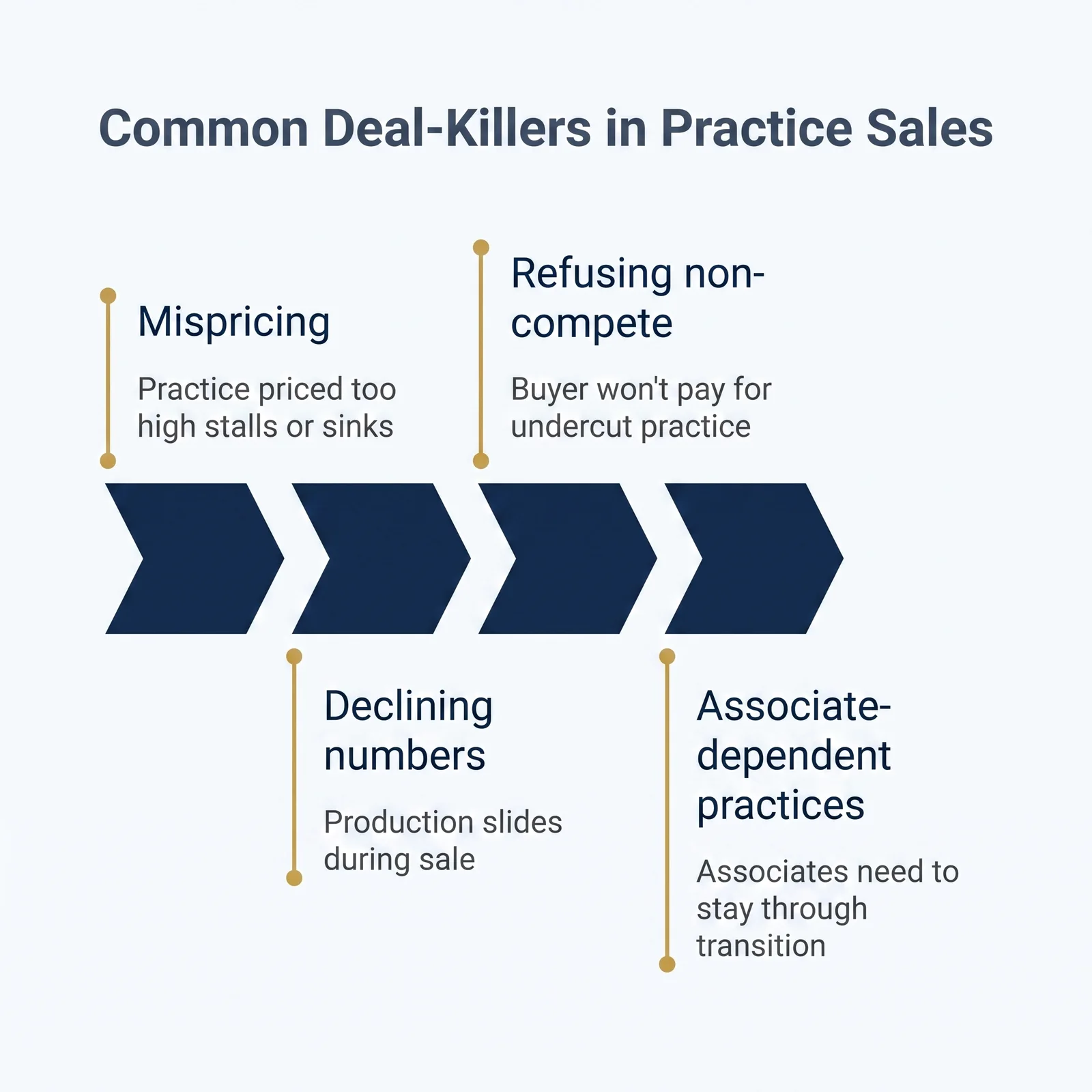
The most common deal-killers are predictable, which means they are preventable. Mispricing is the big one. A practice priced too high stalls or sinks before it gets traction, and it is the number-one reason a sale falls apart.
A few others come up again and again:
- Declining numbers while on the market. Production should be at least flat versus the prior year or two, ideally growing. A slide during the sale makes buyers nervous and invites them to renegotiate the price downward.
- Refusing to sign a non-compete. A buyer will not pay for a practice the seller could undercut by opening a new office down the street after closing. This is usually a deal-breaker.
- Associate-dependent practices. If the practice leans heavily on associates, they generally need to stay through the transition, and part of the price hinges on that handoff going well. This is where the risk of value walking out the door lives.
None of these is exotic. They are the ordinary failure points, and a seller who knows about them in advance can address most of them before going to market.
What selling actually costs, and when you pay
One worry keeps a lot of first-time sellers from even starting the conversation: the fear of paying out of pocket before seeing any result. So it is worth being clear about how the fee works.
With my firm, brokerage is a pure success fee, which means you pay no commission unless your practice actually sells. There is no retainer and no upfront cost. If the practice does not sell, you owe no commission.
The structure is designed to put my incentives squarely alongside yours: I am paid when you get to a successful closing, and not before. For specifics on your situation, the right next step is a confidential consultation.
The bottom line
Selling a dental practice in California is a roughly year-long process, and the parts that determine how it goes are mostly within your control. A defensible valuation sets the foundation. The right buyer depends on what you actually want out of the exit, not just the headline price. And the common failure points, mispricing above all, are predictable enough to plan around.
If you are weighing a sale, or even just want to understand what your practice is worth before you decide anything, that is exactly the kind of conversation I am glad to have. You can learn more about my approach or reach out for a private, no-obligation conversation whenever you are ready.