

Valuations
How to Use EBITDA Multiples in a Dental Practice Valuation
TL;DR
- An EBITDA multiple values your practice on its profit, not its revenue: you take normalized earnings and apply a market multiple to get an estimated value.
- EBITDA means earnings before interest, taxes, depreciation, and amortization. It is a plain measure of the operating profit your practice produces before financing and accounting choices.
- The step that moves the number most is normalizing owner’s compensation to a fair market level. Skip it and you get the wrong value.
- In the current market, healthy practices commonly trade well above the old “3 to 4 times EBITDA” rule of thumb, but the exact multiple depends on size, profitability, hygiene contribution, and how much the practice leans on one dentist.
- The ranges below are general market observation, not an indication of what your specific practice is worth. A real appraisal is the only way to determine that.
If you have ever received an offer or read a market report that values a dental practice at something like “5.5 times EBITDA,” you may have felt it read more like an algebra problem than a number you could act on. If so, you are not alone. EBITDA multiples are the language buyers, investors, and dental service organizations actually use, yet most dentists were never taught how they work.
In this post, I’ll cover what EBITDA is, how to calculate it for a dental practice, why the normalized version is the one that matters, what multiples look like in today’s market, and how to use all of it without mistaking a rule of thumb for an actual valuation. The goal is simple: by the end, an EBITDA multiple should feel like a tool you understand, not a number someone hands you.
What is EBITDA, and why does it matter for a dental practice?
EBITDA is earnings before interest, taxes, depreciation, and amortization, a plain measure of the operating profit your practice generates before financing and accounting decisions enter the picture. In other words, it strips out the costs that vary from owner to owner (how much debt you carry, your tax situation, how you depreciate equipment) so a buyer can compare the underlying earnings of one practice against another.
That comparison is the whole point. The value of any practice is built on its cash flow, the risk attached to that cash flow, and the return a buyer can expect, not on its top-line collections. This is why sophisticated buyers, and DSOs in particular, anchor on EBITDA rather than revenue. A practice can collect a great deal and keep very little, and EBITDA is where that difference shows up.
If you want the formal version of this, certified practice valuations apply income-based methods built on exactly this logic, capitalizing or discounting an earnings stream rather than applying a flat percentage to revenue. Industry guides to dental valuation describe the same income-based methods, where a practice’s net earnings are converted into a value using a capitalization or discount rate.
How do you calculate EBITDA for a dental practice?
You calculate EBITDA by starting with net income and adding back four expenses: interest, taxes, depreciation, and amortization. That gives you the practice’s operating profit before those financing and accounting items distort the picture.
Here is a simplified illustration with round numbers. Say a practice reports $200,000 in net income. You add back $40,000 of loan interest, $90,000 in income taxes, $50,000 of equipment depreciation, and $20,000 of amortization. The EBITDA works out to $400,000. The figures are hypothetical and only meant to show the mechanics.
That raw EBITDA, though, is not the number a serious buyer uses. Reported earnings are shaped by how the owner runs the business: an above-market owner salary, a vehicle on the books, a family member on payroll, a one-time legal bill. To value the practice fairly, a buyer adjusts for all of that. The add-back process typically reflects owner compensation, discretionary or personal spending, and unique or non-recurring expenses. That adjusted figure is called normalized EBITDA, and it is where most of the real work happens.
What is normalized EBITDA, and why does it change the number so much?
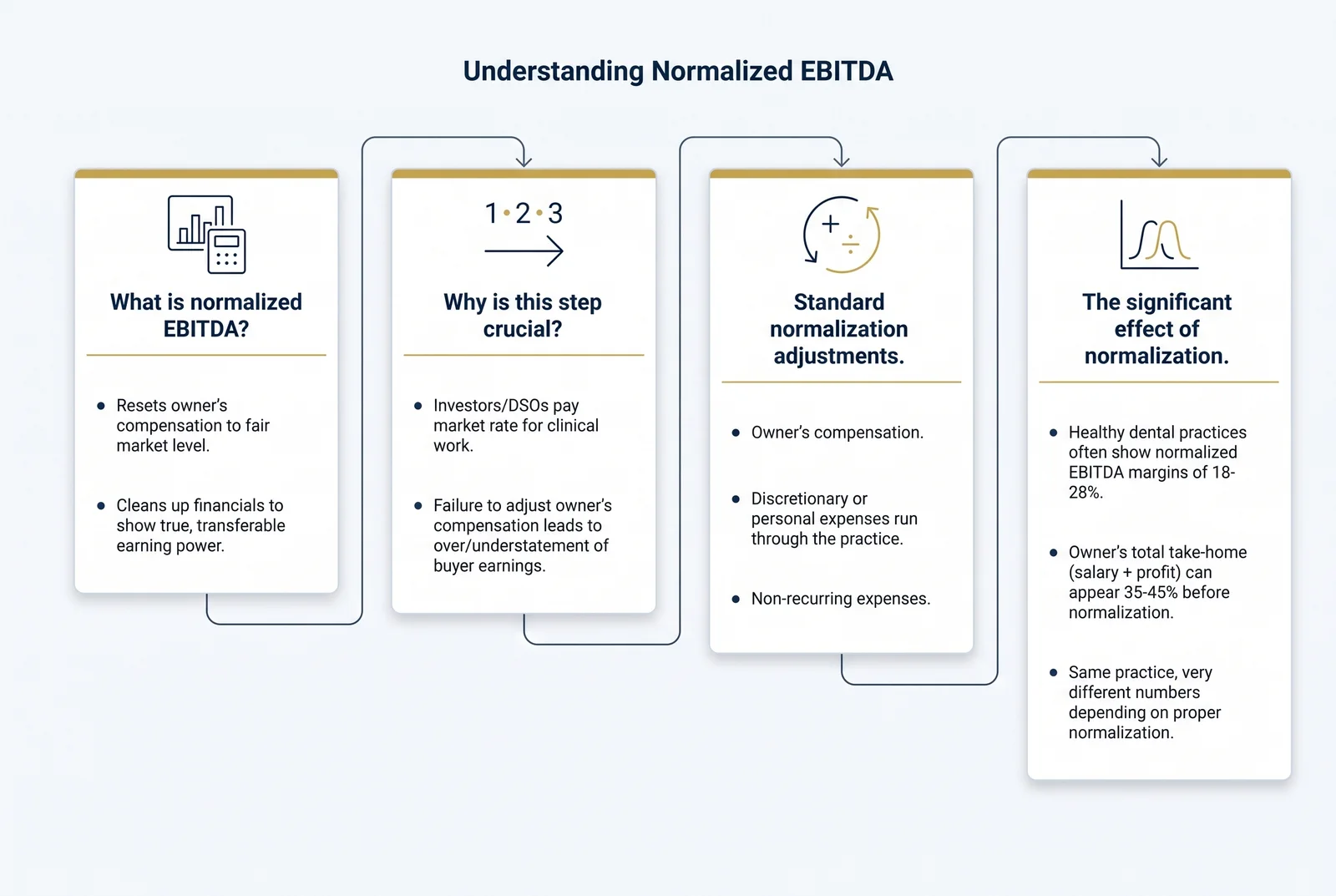
Normalized EBITDA adjusts your reported earnings to reflect what a buyer would actually inherit, and the single biggest adjustment is resetting the owner’s compensation to a fair market level. Normalization simply means cleaning up the financials so they show the true, transferable earning power of the practice rather than the particular way the current owner runs it.
In my experience, this is the most-missed step in the entire exercise, and it is the one that most often produces a wrong number. Many people, including plenty of generalist appraisers, do not fully understand how an investor or DSO buyer thinks about a practice. A buyer is going to pay a dentist a market-rate salary to do the clinical work. The earnings left over after that salary are what the buyer is really purchasing. If you do not adjust the owner’s compensation to a fair market level first, you either overstate or understate the earnings available to a buyer, and the valuation is off from the start.
The standard normalization adjustments usually include:
- Owner’s compensation, reset to what it would cost to hire a dentist to do the same clinical work at market rates.
- Discretionary or personal expenses run through the practice, such as a personal vehicle, travel, or meals.
- Non-recurring expenses, like a one-time legal fee, a major equipment purchase, or a relocation cost that will not repeat.
The effect is not cosmetic. After resetting compensation to market and cleaning up the add-backs, a healthy general dental practice often shows a normalized EBITDA margin in the range of 18 to 28 percent, even though the owner’s total take-home (salary plus profit) can look closer to 35 to 45 percent before normalization. Same practice, very different numbers, depending on whether you do this step properly.
Why do earnings matter more than revenue?
Earnings matter more than revenue because two practices with identical collections can deliver completely different profits, and value follows profit. Revenue tells you how busy a practice is. It does not tell you how much of that activity actually reaches the bottom line.
Rules of thumb are only rules of thumb. The familiar shorthand that a dental practice is worth around 70 percent of revenue hides how many variables actually move the number. A lean practice with a market-rate doctor salary and tight overhead is a very different investment from one with the same collections but bloated staffing and an above-market lease, yet a revenue multiple treats them as twins.
The data backs this up. When one accounting firm completed 46 dental practice valuations and compared them to the rules of thumb, it found the shortcuts undervalued practices badly: on average, a real appraisal came in about 62 percent higher than the value implied by the 0.8 times revenue rule. In that study, not a single practice fell below the high end of the old 3 to 4 times EBITDA rule of thumb either. Leaning on revenue alone, or on a stale earnings multiple, can leave a lot of value undiscovered.
What EBITDA multiple does a dental practice sell for?
It varies widely, but in the current market healthy practices commonly trade in the mid-single to low-double-digit range of EBITDA multiples, well above the old 3 to 4 times rule of thumb. The multiple a given practice earns depends heavily on its size, profitability, and risk profile.
As a rough map of where the market sits, recent industry reporting describes general ranges along these lines:
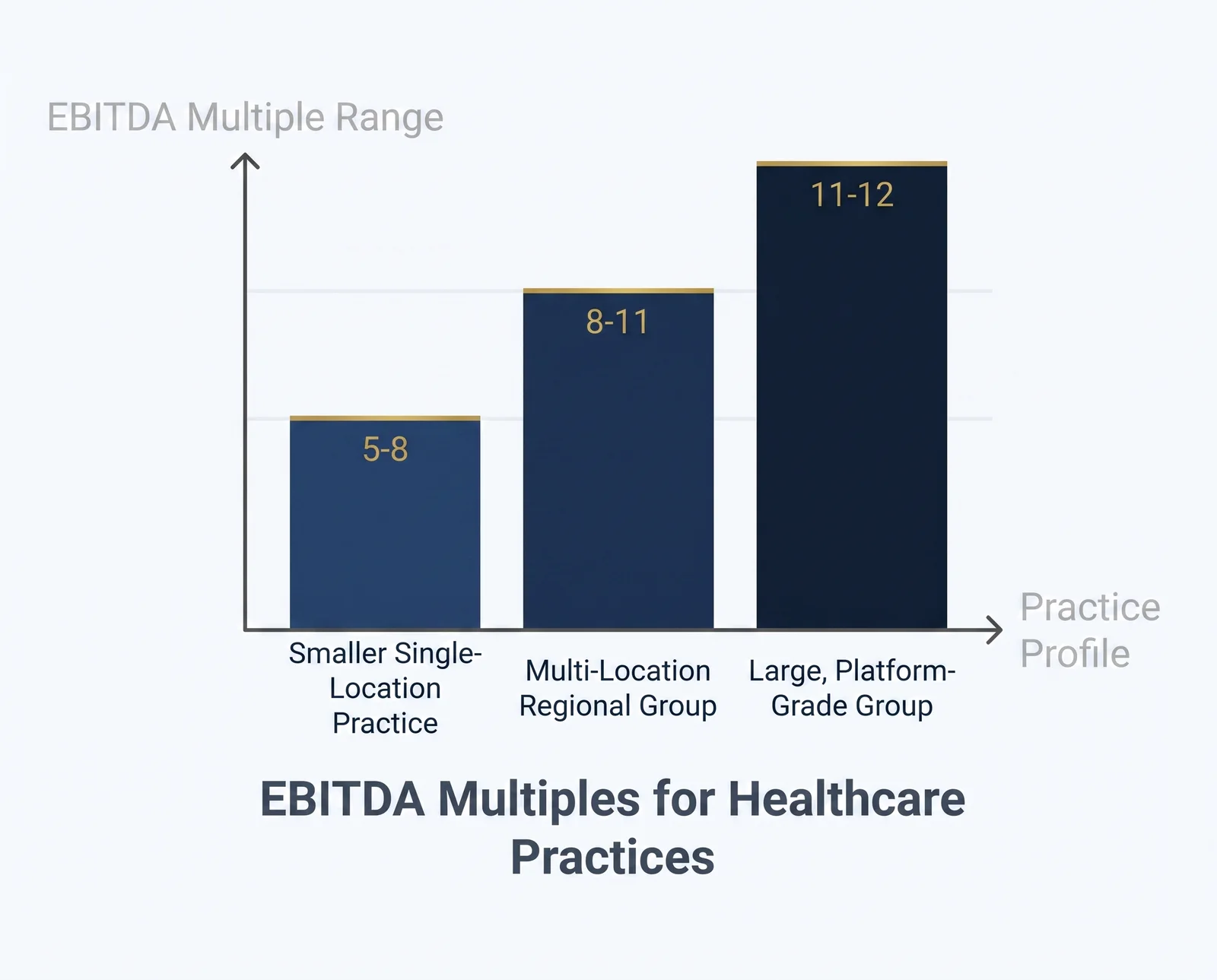
Investment-banking analyses of the dental market put platform-level deals around 9 to 11 times EBITDA, with smaller add-on practices in the 5 to 8 times range. Other 2026 market summaries describe healthy practices trading at roughly 5 to 11 times adjusted EBITDA, with the largest, fastest-growing groups reaching the top of that band. Deal activity remains real: one large DSO closed its acquisition of a 60-practice group in September 2025, a reminder that buyers with capital are still active.
A necessary caution: these ranges are general market observation, not an indication of what your specific practice is worth. Multiples compress and expand with the economy, the buyer pool, and dozens of practice-specific factors. The only way to know your number is a proper appraisal. If you are preparing for an eventual exit, a certified valuation is the foundation of any credible dental practice sales process, because it gives you a defensible price rather than a guess.
What makes one practice’s multiple higher than another’s?
Two practices with the same EBITDA can still command very different multiples, because buyers price risk and durability, not just current profit. A few factors move the needle more than the rest.
Scale is often the single biggest driver. A larger, multi-location group spreads its risk across more providers and locations, so buyers treat its earnings as more durable and pay a higher multiple than they would for a single small office.
Hygiene contribution matters because recurring hygiene visits are the closest thing a practice has to predictable, repeat revenue. Practices with a strong, well-run hygiene program tend to support stronger multiples for exactly that reason.
Provider concentration cuts the other way. When one dentist personally produces most of the clinical work, the practice is fragile in a buyer’s eyes, since that production may walk out the door after closing. Industry analysis found that practices where the owner performs 90 percent or more of production can see valuation reductions of roughly 10 to 20 percent. This is where personal-goodwill risk lives, and it is one of the most common reasons an otherwise profitable practice gets marked down.
Payer mix rounds it out. A balanced blend of commercial and PPO patients, with manageable Medicaid exposure, reads as more stable and underwritable than a heavily concentrated or volatile mix.
Why can a profitable practice end up with only corporate buyers?
A highly profitable practice can end up with only corporate or investor buyers because, once its earnings push the value above what a bank will lend an individual dentist, the realistic buyer pool narrows to investors and DSOs. This catches a lot of owners by surprise: strong numbers can quietly move your practice out of reach of the dentist down the street.
Here is the mechanism. A highly profitable practice gets valued on its cash flow, and that earnings-based value can climb above the old 70-percent-of-revenue rule, sometimes to 100 or even 120 percent of revenue. At that point, conventional lenders generally will not finance an individual dentist for the full amount, because banks cap how much they will lend relative to revenue. The deal only works for a buyer with deeper capital, which usually means an investor group or a DSO.
There is also a structural reason corporate buyers can pay more. Folded into a larger group, a practice’s earnings carry less risk and gain access to scale, so the same cash flow is simply worth more inside a platform than it is standing alone, a dynamic sometimes called multiple arbitrage. The same analysis notes that rising graduate debt has shrunk the pool of young dentists able to buy practices outright, which has pushed more sellers toward corporate buyers.
That shift is visible in the national data. As of 2023, 72.5 percent of U.S. dentists were practice owners, down from 84.7 percent in 2005, while DSO affiliation has more than doubled over the past decade. The trend is most pronounced among younger dentists, with more than one in four within ten years of graduation now affiliated with a DSO.
None of this means a DSO sale is the right move. A DSO is not for everyone, not every practice is even DSO-acquirable, and the premium price a DSO pays usually comes with a multi-year commitment to stay on and work for them. The point is only that your own profitability helps decide who can realistically buy your practice, which is worth understanding before you explore your options.
How should you actually use an EBITDA multiple?
Treat an EBITDA multiple as a sanity check, not a valuation. The multiple is the output of a careful appraisal, not the input you start with. Buyers do not pick a number out of the air and multiply; they normalize earnings, assess the practice’s risk and growth, and the multiple is what falls out of that analysis.
So the right way to use a multiple is to ground yourself, not to price your practice. Knowing that healthy practices trade in a certain range tells you whether an offer is in a sensible neighborhood. It does not tell you your number, because your number depends on your normalized earnings and your practice’s specific risk profile. Anyone who quotes you a precise value from a revenue figure and a rule of thumb, without normalizing your earnings, is guessing.
If you want a real figure, the path is straightforward: get a certified, USPAP-compliant valuation prepared by a Certified Valuation Analyst, built to hold up with lenders, buyers, and your own planning. From there, an EBITDA multiple stops being abstract and becomes something tied to your actual practice. You are always welcome to start that conversation with a confidential consultation.
The bottom line
An EBITDA multiple is not as mysterious as it first looks once you see what sits underneath it. It is built on normalized earnings, the profit a buyer would actually inherit after paying a dentist a fair market salary, and then scaled by a multiple that reflects your practice’s size, stability, and growth.
Revenue tells part of the story. Earnings tell the rest, and the normalization step is where the truth lives. If you are weighing an offer, planning an exit, or simply want to understand what you have built, start with a defensible valuation rather than a rule of thumb. I’m always glad to walk through what the number really means for your practice.
The market ranges discussed here are general observations and not an indication of any specific practice’s value. Determining the value of your practice requires a formal appraisal.